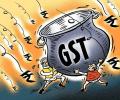
The CAG has found that the Union government in the very first two years of the GST implementation wrongly retained Rs 47,272 crore of GST compensation cess that was meant to be used specifically to compensate states for loss of revenue.

Finance Minister Nirmala Sitharaman on Monday introduced two bills in the Lok Sabha to levy excise duty on tobacco and tobacco products, and a new cess on manufacturing of pan masala, which will replace the GST compensation cess on such sin goods.

Under the GST law, states were guaranteed to be paid for any loss of revenue in the first five years of the GST implementation from July 1, 2017.

Three laws passed in Parliament could boost central revenues, reshape GST cess flows, shift MGNREGA costs to states and create new budget headroom ahead of the 2026-2027 Union Budget, points out A K Bhattacharya.

The Centre has projected reining in its fiscal deficit at 3.3 per cent of GDP in FY19.

States are planning to pass resolutions in their legislative assemblies; however, such tactics will be used as the last resort if the Centre continues to stall allocations.

Finance ministry sources have countered CAG audit finding of central government wrongly retaining Rs 47,272 crore of GST compensation cess meant for states, saying temporary retention cannot be termed as diversion.
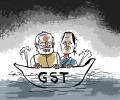
In the current financial year, the Centre released nearly Rs 1 lakh crore compensation to the states till September.

Banks are receiving requests for cancellation of approved car loans, in view of the implementation of GST rate cut, which will lower the price of passenger vehicles and also lead to subsequent reduction in the amount needed to purchase them. It is to be noted that the 56th GST Council meeting earlier this month, approved substantial reduction in the GST rate for cars for up to 1,200 cc to 18 per cent from the existing 28 per cent.

The demand for extension of the GST cess regime among others was made by several state finance ministers at a pre-budget consultation called by Union Finance Minister Nirmala Sitharaman in New Delhi. Besides, many states also demanded raising the share of the Union government in the Centrally Sponsored Schemes (CSS). Currently, the central government and state government share in some CSS is 60:40 while in others it is 75:25.

Domestic passenger vehicle dispatches from companies to dealers rose 13 per cent year-on-year to 449,616 units in January with demand remaining robust owing to GST rate rationalisation and subsequent dip in prices, industry body SIAM said on Friday.

India's gross GST collection increased by 8.1 per cent to over Rs 1.83 lakh crore in February, driven by higher import revenues and improved domestic sales. Despite some states reporting negative or below-average growth, experts see the overall trend as a sign of a maturing tax ecosystem and a confident domestic market.

Gross GST collections rose 6.1 per cent to over Rs 1.74 lakh crore in December 2025, even as sweeping tax cuts slowed down growth in revenues from domestic transactions, according to government data released on Thursday.

GST collections in March slipped below the psychological Rs 1-lakh crore mark for the first time in four months to Rs 97,597 crore as the COVID-19 lockdown that shut most businesses compounded tax collections in an already sluggish economy.
The shortfall in GST compensation payable to states in the current fiscal is estimated at Rs 2.69 lakh crore, of which Rs 1.58 lakh crore would have to be borrowed this year. The Centre expects to collect over Rs 1.11 lakh crore through cess on luxury, demerit and sin goods which will be given to the states to compensate them for the shortfall in revenue arising out of GST implementation. The remaining Rs 1.58 lakh crore would have to be borrowed to meet the promised compensation to states under the Goods and Services Tax (GST) regime.
The government on Tuesday informed Rajya Sabha that GST compensation of Rs 17,176 crore is pending to states as on June 2022. Replying to supplementaries during the Question Hour, Minister of State for Finance Pankaj Chaudhary said the Centre is giving GST compensation to states for five years. He said even during Covid times when no GST was collected, the Government of India had given compensation to states after taking loans of Rs 1.1 lakh crore and 1.59 lakh crore during 2020-21 and 2021-22.

'In case a particular industry has not passed on the benefits and if we receive complaints, we will take up the matter with the industry body concerned.'
The domestic cigarette industry is expected to see a 6-8 per cent volume contraction next fiscal following the imposition of additional excise duties and increase in goods and services tax (GST) rates from February 1, Crisil Ratings said on Wednesday.
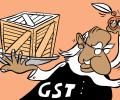
The Centre has cleared the entire GST compensation payable till date by releasing Rs 86,912 crore to states, the finance ministry said on Tuesday. Of this, Rs 25,000 crore is released from the GST compensation fund and the balance Rs 61,912 crore is being released by the Centre from its own resources pending collection of cess. Of the total compensation released, Rs 17,973 crore is towards April and May dues, Rs 21,322 crore towards February-March dues and Rs 47,617 crore is the balance of compensation payable up to January 2022.
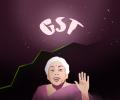
Lower rates effectively increase disposable income, strengthen purchasing capacity, and support broader consumption growth.

'We are seeing a lot of people with helmets visiting our showrooms.'

A shift appears underway in India's tax landscape. States with relatively smaller tax collections like Odisha and Telangana are emerging as the fastest-growing contributors to indirect and direct tax collections, respectively.

The finance ministry on Friday said it has proposed a two-slab GST rate structure to the Group of Ministers (GoM), along with special rates for select items.

GST Reform 2.0, which trims tax slabs from four to two, signals a push for demand-led growth, and together with recent income tax cuts, sets the stage for sustained economic growth, experts said. The Goods and Services Tax (GST) Council on September 3 approved an overhaul of the indirect tax regime by taxing essentials at 5 per cent and other goods at 18 per cent. A new 40 per cent tax will be applicable on luxury and sin items.

The GST Council on Wednesday approved two slabs of 5 per cent and 18 per cent effective from September 22, the first day of Navaratri.

The demand for passenger vehicles (PVs) is expected to sustain even beyond the ongoing festival season as a new set of customers, those who gained confidence to buy cars following the recent GST rate cuts, will begin to visit dealerships now, said Shailesh Chandra, president of the Society of Indian Automobile Manufacturers (Siam), on Wednesday.

'In the January-August period, the share of hatchback in the overall PV industry sales was about 22.4 per cent. In the September-October period, the share of hatchbacks has come down to 20.4 per cent. In just October, their share was just 20 per cent. This is simple wholesale data from industry body SIAM.'

Any residual amount left in the Compensation Fund after five year compensation period shall be shared equally between the Centre and the states.

The small sports utility vehicle (SUV) segment - comprising models less than 4 metres in length - could witness the "maximum" growth among all categories in the coming months following the recent goods and services tax (GST) rate rationalisation, Tarun Garg, chief operating officer of Hyundai Motor India (HMIL), said.

'Rates go up, revenues go up, and the need for compensation diminishes.'

The Congress party has criticized Prime Minister Narendra Modi's handling of GST reforms, calling them inadequate and demanding an apology for the tax imposed on essential items. They argue that the reforms are merely a 'band-aid' solution and that the government should address the states' demand for extended compensation.
States will remain "net gainers" of the proposed GST rate rationalisation exercise with their GST revenues, including devolution, estimated to be over Rs 14.10 lakh crore this fiscal, according to an SBI Research report released on Tuesday. It said that, as was evidenced in the earlier exercise of GST rate rationalisation in 2018 and 2019, an immediate reduction in rates can cause a short-term dip of around 3-4 per cent in month-on-month collections (roughly Rs 5,000 crore, or an annualised Rs 60,000 crore), revenues typically rebound with sustained growth of 5-6 per cent per month.
Gross GST collection increased 7.5 per cent to about Rs 1.96 lakh crore in July on higher domestic revenues and taxes from imports. Gross Goods and Services Tax (GST) mop-up was Rs 1.82 lakh crore in July 2024. Last month, the collection was Rs 1.84 lakh crore.

States may face a GST compensation shortfall of Rs 3 lakh crore in the next financial year, a situation that will force them to borrow more from the markets, says a report. The states may face a shortfall of Rs 2.7-3 lakh crore as Goods and Services Tax (GST) compensation from the Centre next fiscal. Out of that amount, the shortfall from cess collections will be at Rs 1.6-2 lakh crore, according to an Icra report released on Monday. In FY21, the states were facing a shortfall of Rs 1.1 lakh crore in GST compensation from the Centre but over 90 per cent of that amount has been cleared now.

The GST Council, in its meeting on Saturday, is likely to decide on reducing tax rates on life and health insurance premiums, while hiking it on high-end wrist watches, shoes and apparels, besides considering a separate 35 per cent tax slab for sin goods. The 55th meeting of the GST Council, chaired by Union Finance Minister Nirmala Sitharaman and comprising state counterparts, is likely to discuss rate rejig in about 148 items, besides, it will also deliberate on bringing Aviation Turbine Fuel (ATF), a major component for airline industry's operation cost, in the Goods and Services Tax (GST) fold.
These changes certainly bring India's GST a lot closer to what an ideal GST would look like, points out Karan Bhasin.
Leading automakers Maruti Suzuki, Hyundai, Mahindra, and Tata Motors saw a dip in dispatches to dealers in August amid dip in demand with many prospective buyers postponing their buys anticipating a reduction in vehicle prices on account of the new GST framework. The country's largest carmaker Maruti Suzuki India reported an 8 per cent year-on-year dip in dispatches of passenger vehicles in the domestic market last month.

The cess collected on cars as also tobacco and coal will be used to compensate the revenue loss of states by implementing GST.

Prime Minister Modi urged the people of the country to take pride in selling and buying indigenous goods.

The GST Council on Wednesday approved a two-tier rate structure of 5 and 18 per cent, which will be implemented from September 22.
 © 2026 Rediff.com - Investor Information - Advertise with us - Disclaimer - Privacy Policy - Sitemap - Feedback - About us - Terms of use - Grievances